
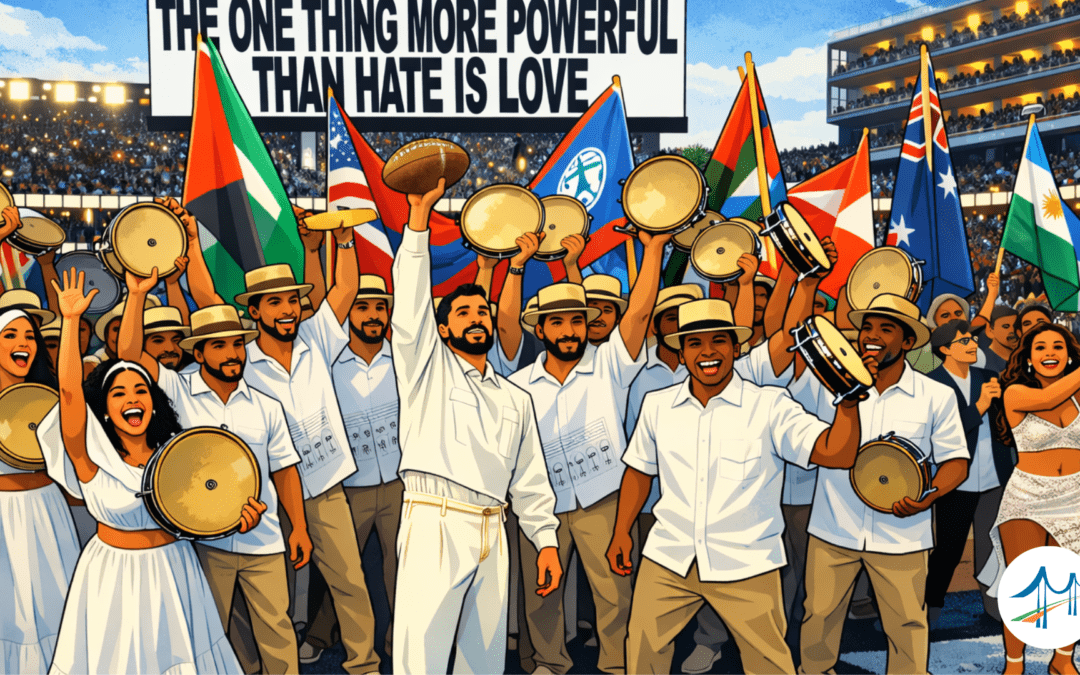
There are Super Bowl halftime shows you remember because of the spectacle.
And then there are the ones you remember because they feel like home.
Bad Bunny’s performance wasn’t framed as a protest or a statement. It felt like something much more familiar: a reflection of how millions of us actually live, love, celebrate, and move through this country every single day.
For 13 minutes, Latinidad wasn’t a talking point.
It simply existed onstage, in all its joy, rhythm, humor, and everyday detail.
A Show That Looked Like Real Life
What made the show resonate wasn’t just the music or the cameos. It was the world he built around them:
- A town square with neighbors chatting
- A bodega on the corner
- A wedding, domino table, boxers training
- Field workers in straw pavas
- Plena percussion and salsa horns
- A pan-American parade of flags
- The porch of La Casita, warm and familiar
These weren’t symbols.
They were scenes you can find in Miami, Chicago, San Juan, Houston, Los Angeles, New York, places where Latino culture shapes the rhythm of ordinary days.
For many Latinos, it felt like being seen without explanation.
No translation required. No apology or advocacy attached.
Just life as we know it.
A Moment Shared Across Communities
One of the most unexpected reactions came from social media.
People from every background jumped into the comments, sharing recognition, humor, and pride in ways that felt almost like a digital block party.
Latinos immediately saw themselves in the scenes onstage.
One person wrote, “Lo único más poderoso que el odio, es el amor,” echoing Benito’s final message.
Another joked, “Benito dando clases de geografía,” celebrating the parade of countries named onstage.
Others saw memories reflected back to them — “The kid sleeping on three chairs at the wedding is all of us in childhood.”
But what surprised many was how non-Latino viewers joined in, not as outsiders, but as participants.
A YouTube commenter said, “I’ve never been so proud to be Puerto Rican… and I’m Irish,” laughing at how contagious the energy felt.
Across threads, viewers were practicing their Spanish in real time, cheering through the comments.
And families everywhere were reacting to the wedding couple: “How many people came to your wedding?”
“Idk, like 70,000,” someone joked.
Others shared cultural touchstones: the meaning of the white outfits, the history of sugar-cane workers, even the cameo of Toñita from the iconic Caribbean Social Club in New York, a place that has been a cultural home for Puerto Ricans and other Latinos since the 70s.
These reactions were about recognition, the kind that makes people lean in, curious and welcomed, instead of pushed away.
Latinidad wasn’t presented as a moment. It was presented as part of the American experience that millions already share.
Joy as a Message
At a time when everything feels tense, many expected confrontation.
But Bad Bunny chose something else:
A screen that read, “The only thing more powerful than hate is love.”
His choice to perform almost entirely in Spanish wasn’t defiance.
It was comfort.
Like speaking in the language you dream in, even when the whole country is watching.
Why It Mattered
It mattered because it didn’t try to be a lesson.
It mattered because it was fun.
And it mattered because it showed Latin culture the way many of us experience it:
- Family-centered
- Community-rooted
- Musical, playful, layered
- Proud, but not loud on purpose
- Open to anyone willing to listen
This was everyday Latinidad, on the biggest stage in the country, presented with warmth instead of warning, joy instead of tension.
A Celebration That Included Everyone
What made the night so special wasn’t just who saw themselves in the performance.
It was how many others recognized something familiar in it, too.
You didn’t need to speak Spanish to feel the rhythm.
You didn’t need to grow up in a Latino household to understand the scenes of work, community, and celebration.
You only needed to show up with curiosity, and millions did.
That’s the quiet power of the night: Latinos weren’t just acknowledged. They were part of a shared national, (actually, a GLOBAL) moment, not set apart from it.
At Cool, we spend our days thinking about community, how people connect, how they build belonging, and how identity shows up in daily life.
February 8 felt like a reminder that representation doesn’t always need to come with an explanation.
Sometimes it just needs joy.
Sometimes it just needs the truth:
We’re still here.
We always were.
And we’re part of the story.
Image:
Illustration created with the assistance of AI, based on a conceptual recreation of Bad Bunny’s halftime show. Not affiliated with or endorsed by the NFL, Bad Bunny, or event organizers.